
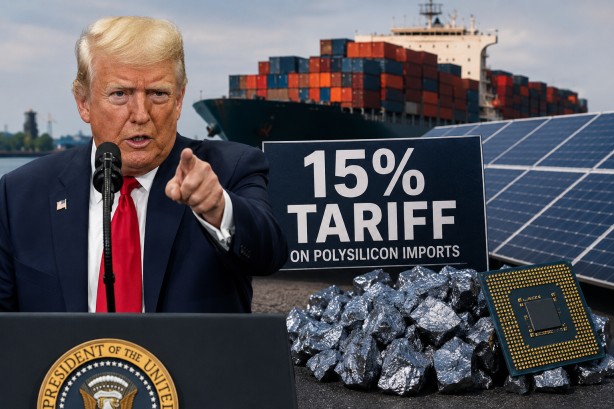
In a strategic move to bolster domestic manufacturing and lessen dependence on China, President Donald Trump has announced a 15% tariff on imported goods utilizing polysilicon, a crucial component in the production of semiconductors and solar panels. The tariff is set to take effect on December 4. Polysilicon, known for its ultra-pure form, is essential in creating semiconductors that drive artificial intelligence systems and data centers, as well as solar cells and panels. China, which dominates global production of polysilicon, has been identified as a key player in this sector.
The United States has set minimum import prices for polysilicon products, including $21 per kilogram for polysilicon itself, $100 per kilogram for ingots and wafers, $0.22 per watt for solar cells, and $0.38 per watt for solar modules and panels. These measures are intended to enhance the competitiveness and financial sustainability of U.S. polysilicon producers, thereby reinforcing vital supply chains tied to economic and national security interests.
Beijing has reacted critically to these new tariffs, arguing that the U.S. is exploiting national security concerns to unjustly limit Chinese business activities. They caution that such protective measures could potentially lead to disruptions in trade relations between the two countries. Meanwhile, China continues to experience robust export growth, particularly in sectors like electronics and artificial intelligence, which are central to high-value manufacturing.
Currently, the U.S. polysilicon industry is supported by two major production facilities located in Michigan and Tennessee, operated by Hemlock Semiconductor and Wacker Chemie, respectively. The new tariff policy is part of a broader initiative that also includes provisions for the U.S. government to offer incentives to companies investing in domestic polysilicon and related manufacturing operations.